
Let us metabolize
(I expand sketches from my notes app over the last weeks. A rush of thoughts written under trees and on taxis and subways)

Let us metabolize…
something beyond fear. Let us process the things that are happening to us, let us live the life that we are in.
Let me feel something besides the constant inner arguing with bad leaders who have proven to be worse than we could have imagined.
(There are three categories of people in the U.S.: 1. Indigenous people whose ancestors were first. 2. Descendants of the enslaved, brought against their will. 3. Immigrants and the descendants of immigrants. A country shall not turn against its own. The descendants of immigrants shall not turn against the nature of migration and the moving of the waters, the tides of change. Do you have any idea how beautiful people can be? Have you ever had a cup of water offered by a person who had nothing? Why are you so limited in your love and imagination? Get the name of Jesus out of your mouth.)
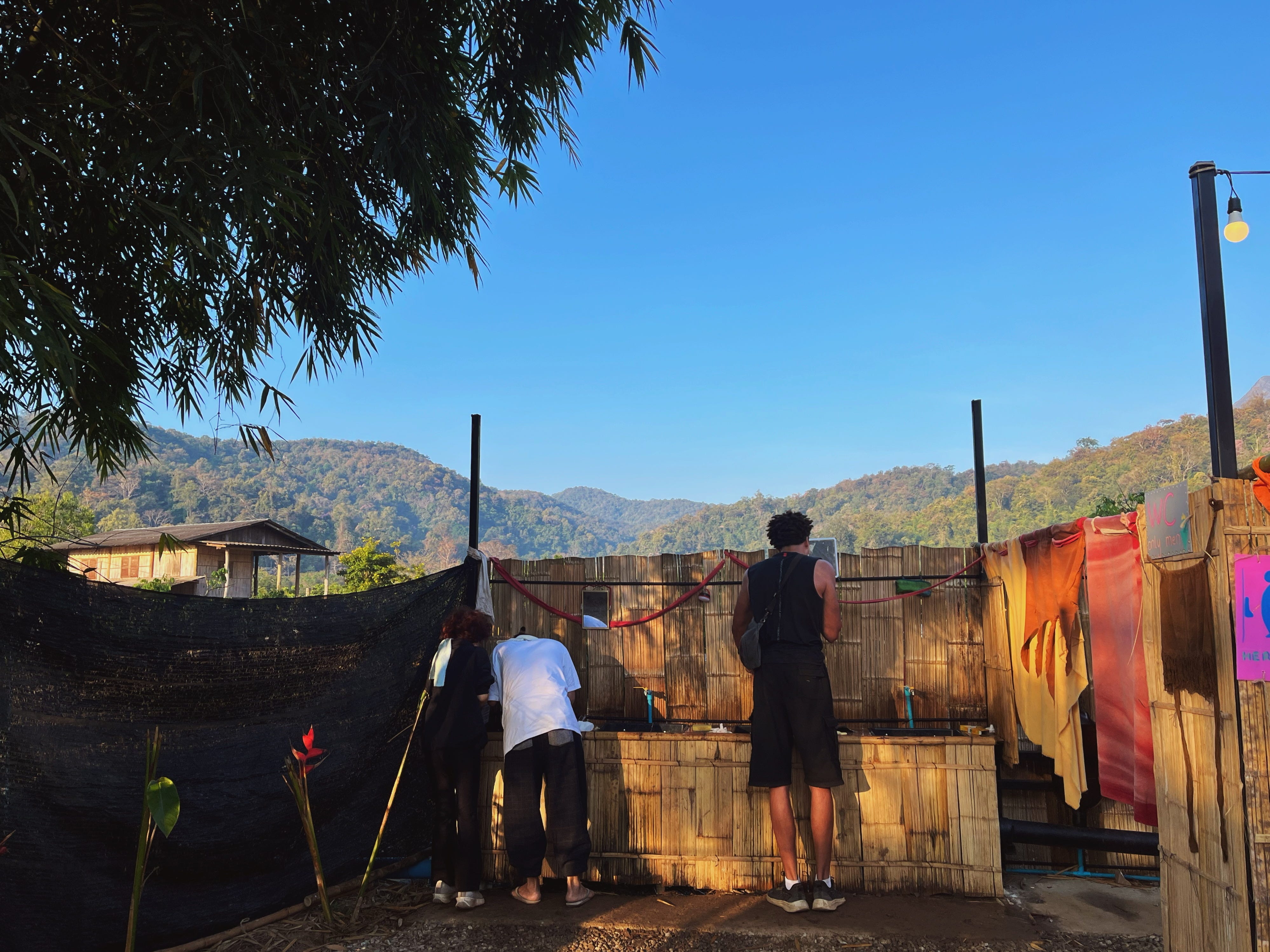
But no, I am still sleeping in the woods, cleaning up after a festival, thinking and digesting, and more than the arguments that no one will hear, I see dust everywhere. Behind the dust, the sun is rising again, and the light illuminates the dust and turns it to gold. I see the pale purple flowers on a vine that is taking over a teak tree. And look, the ever-present mountain, the solid rock.
(How appropriate to meditate in the dust: Ro’s voice guiding, from Psalm 27.
One thing I ask from the Lord, this only do I seek: that I may dwell in the house of the Lord all the days of my life, to gaze on the beauty of the Lord and to seek him in his temple. For in the day of trouble he will keep me safe in his dwelling; he will hide me in the shelter of his sacred tent and set me high upon a rock.)
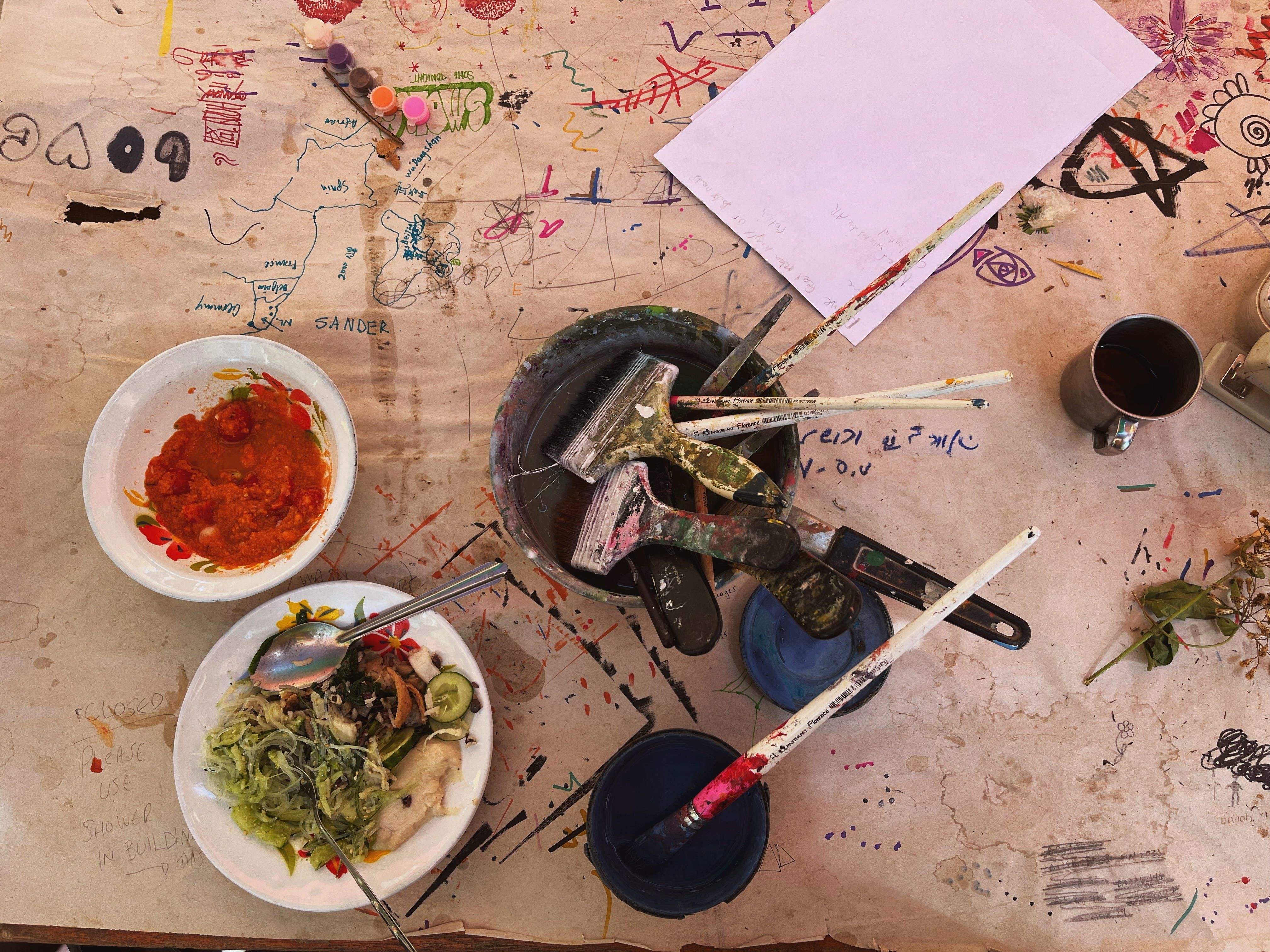
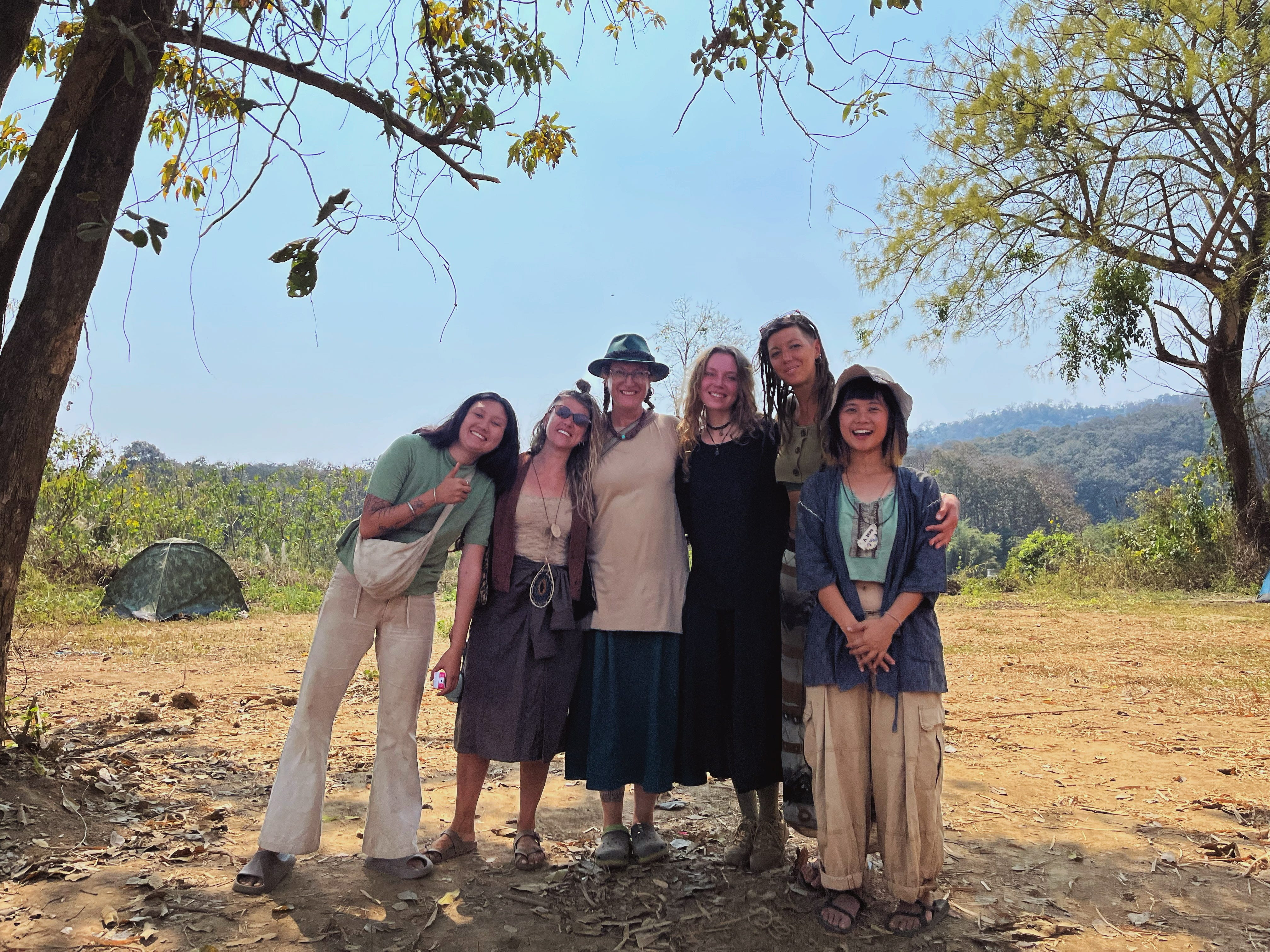
I internalize the smiles of my friends, the sounds that float toward me on the breeze, the feeling of falling asleep to music, the strong voice of the koels in the morning. The faces of people from other places. The taste of daily food made with love in a kitchen formed entirely outdoors. My own discomfort and the ways I overcome it. The people who have come to me, looking for hugs. Kind messages from my beloved. Wandering the festival with a friend. Paint and colors and the feeling of my brush on the canvas. Tea. Warmth of smiles. My husband wandering and playing music: mandolin, banjo, saxophone, djembe, melodica, guitar. The stones, the ground, the tiny trees growing for another year, the kindness of people. Bashkortostan. Kazakhstan. Iran. Japan. Thailand. Canada. The U.S. and China. Siberia. Italy. Korea. I am from, I am from. Georgia (we all tried to learn Georgian dancing with an impromptu lesson in the kitchen). Taiwan. Israel. India. Malaysia. England. Ireland. Poland. These people (and more) are the ones who put the festival together. Can you imagine it?
.
A drive home in a dusty vehicle. The boys wash it. I wash loads of laundry. Packing again, only one day at home, but I manage to visit a friend and play drums outdoors by the river. Then, Bangkok.
I remember one day someone asking a kind of telling question they had found online: If you were looking for your wife in the grocery store, which aisle would you find her in?
Chinua didn’t know- he asked the boys. They also didn’t know. This is because I don’t shop in grocery stores with big aisles. They can’t really imagine it because it doesn’t exist. But finally, Leafy answers.
“Wherever she can be talking to old Thai women.” Everyone agreed. “Yeah, that’s where I always find Mom.”
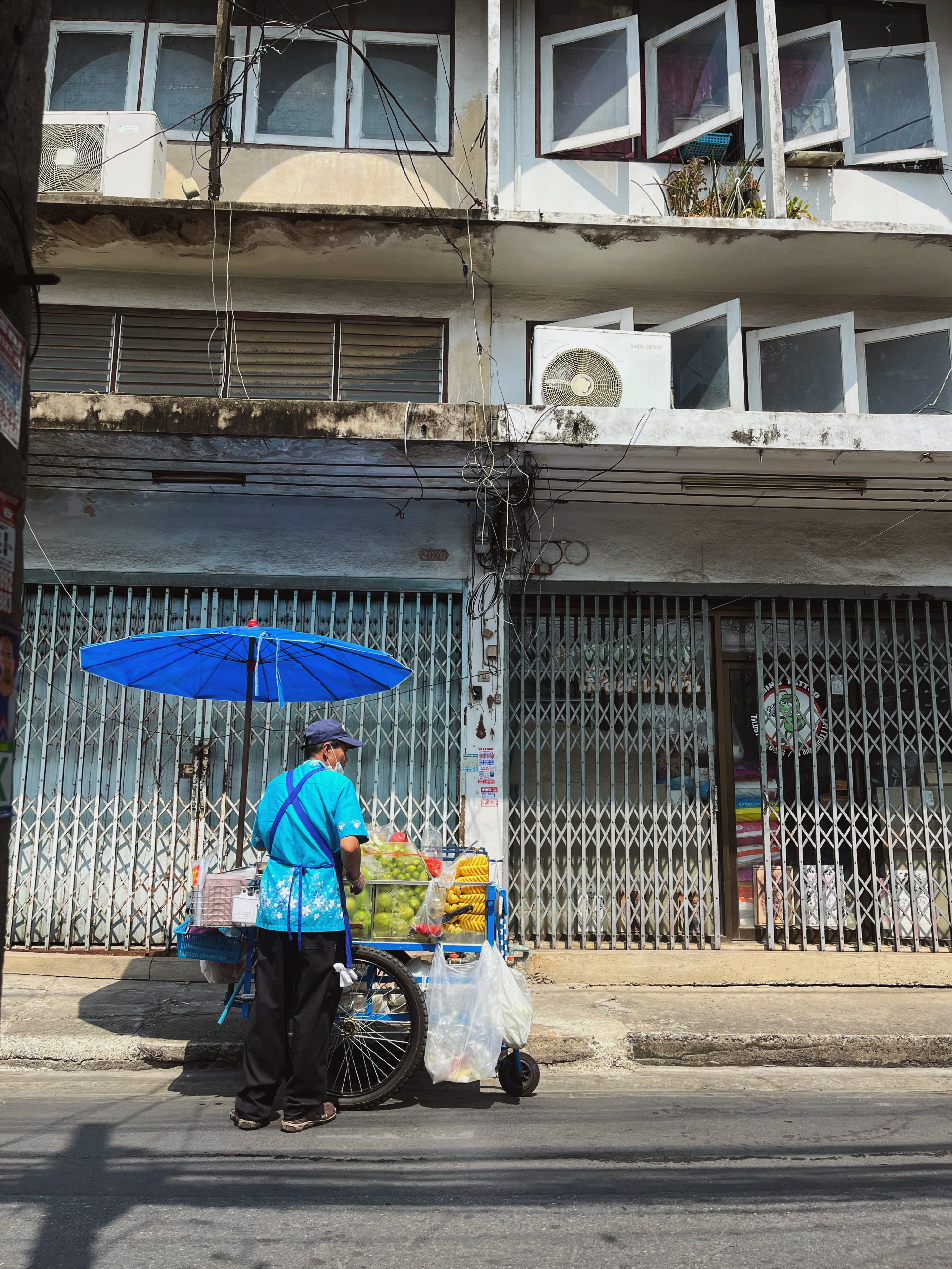
I thought of that conversation today, when I sat talking to a trio of older ladies in Bangkok.
I think about going to Vietnam soon, where I can only smile.
Language does matter. I love having language. But I don’t speak Vietnamese.
I have had lunch and a conversation and now I know the woman talking to me now grew up in Lampang in the north, that she came to Bangkok when she got married, 47 years ago, that she is one of 7 brothers and sisters, that her family is Chinese Thai, and that she has 2 children and 4 grandchildren (two boys and two girls)
She tells me all of this. Then she smiles and says, Welcome, eat, you haven’t been able to eat while we have been talking.
The lady running the restaurant asks if my son is coming to eat- she heard him say som tum! as we walked by. Later, he calls my name, and I look up to see him standing on the balcony of the house with Chinua. They wave. They are so high up in the air, the balcony railing so short. It makes me shiver.
Solomon comes to eat later. And the next day, the three of us sit in the same spot eating together. It is a single metal table under a shade covering. Bangkok is blazing with heat. The lady brings us food and keeps congratulating my boys on their appetites. Very good. Very good. All for eating som tum and sticky rice. One more sticky rice! Very good. Very well done.
.
On the subway, there is a pregnant woman with a stretchy T-shirt that says, mysteriously, Unigrav Money. The illustration below is of a skeleton hand holding a stack of 100-dollar bills. The pregnant woman looks young. Everyone on the subway is meticulous, as though they apparated here, rather than running through the humid Bangkok streets the way we did. The woman sits down.
I am remembering the swirling feeling of a baby in my belly. The rolling and pressing. The sensation, like nothing else, of a back and a hand and a tiny head turning a somersault within me. It feels like not so long ago, and yet, sometimes when people ask me what I did about this or that, I actually can’t remember. And then other things, phrases Chinua and I used to murmur to the babies, always come back like muscle memory. Snippets of movies that we repeated to each one, little songs we sang.
“Wake up, friend owl!” (from Bambi) when they fell asleep while nursing and we wanted them to get a full feed. “Oh there you are, Peter!” (from Hook) when they woke up, or when we squished their faces a little, playing with their tiny cheeks.
Isaac is beside me now on the subway and he is nearly as tall as me. He grew during the festival, he was taller at the end than at the beginning. I have always imagined him remaining at home, the last kid, at the size he was around eleven years old. Now it strikes me that he will remain as a big, tall man-child.
.
We had a problem with our visas that I did not perceive until I was on the night bus from Chiang Mai, in a seat curiously slanted upward, so as to cut off the circulation in my thighs. Rapid thumb typing throughout the night and some extra money and we fixed it, though we had to stay three nights in Bangkok. Thus, the skytrain and subway. This woman in her baffling T shirt.
How do I keep from passing along my anxieties about money? I do not want this to be my legacy. I want to teach my kids to embrace frugality with gratitude, but I do not want to pass along the clenching in my jaw or stomach. Sometimes I feel like I’m doing it wrong. I guess that is not surprising. I am a mother, after all, it is kind of our thing. And perhaps it is just the mall, maybe it is walking by the Dior and Marc Jacob stores. A mall is like an ticking clock for Chinua and me. We have about one good hour in a mall. The smells are nice. I buy some coffee filters from Daiso. A new pair of fake crocs from Big C. Curl cream from Boots.
And then comes the existential dread. I’m sitting and waiting for the kids when everything becomes too glittery, sharp, flat, perfect. Why do we build concrete boxes and live in them? What is this? Why am I in here? It is far from the teak forest where my tent sat for twenty days.
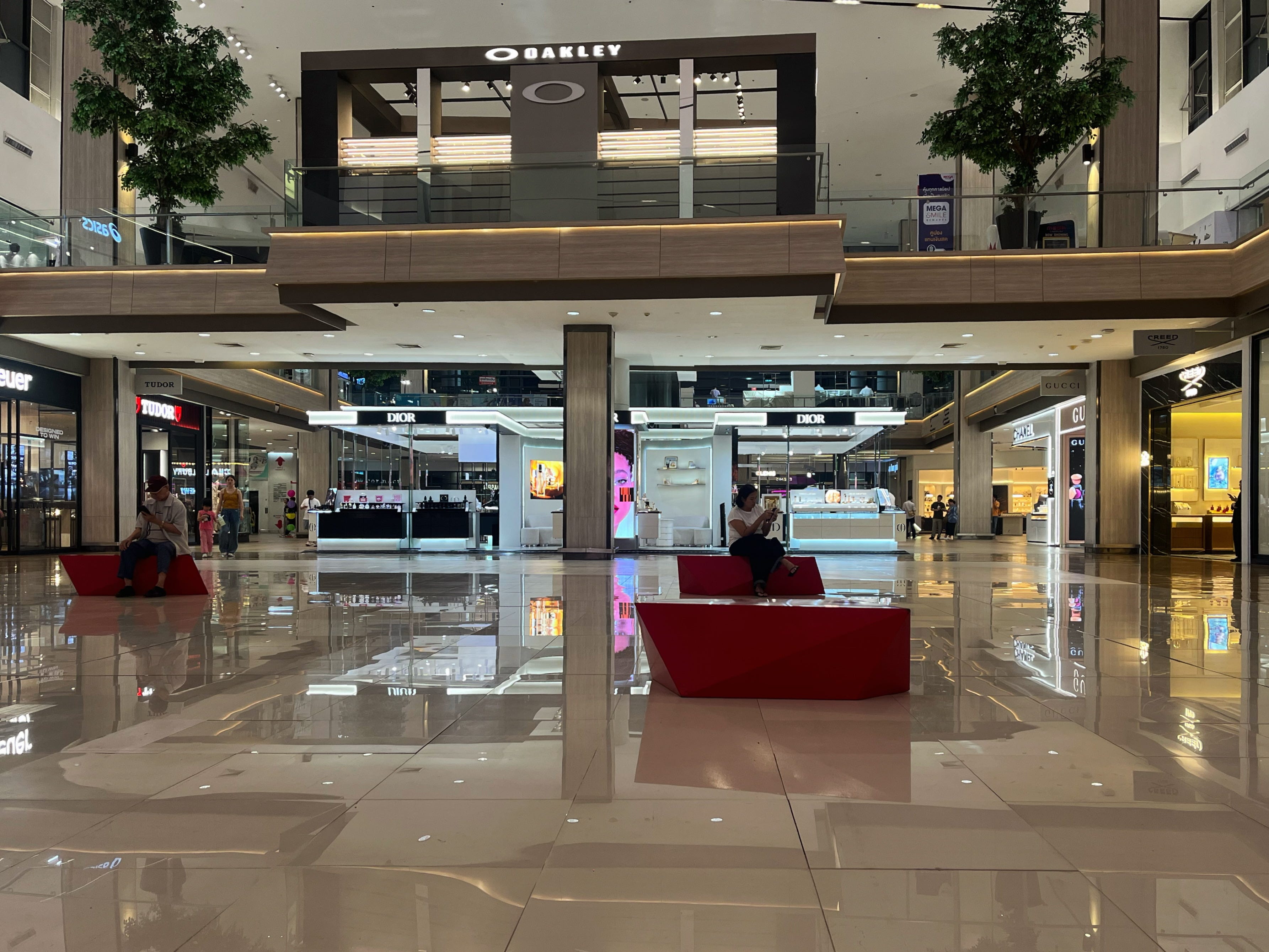
Outside of the mall, I settle back into my skin. How do I live in gratitude? How do I say, no we can’t do that thing right now, no we can’t so many times without making it weird?
Here are free things: the air, your legs, the sunset, the wind. Birds. People walking by. Kids, lets do this! These are human things. And somehow during this gift (absolute treasure, joy, gift) of a trip, I can simply be thankful. I can stop checking the exchange rate and making everyone uncomfortable while wondering if there is any cheaper way to exist.
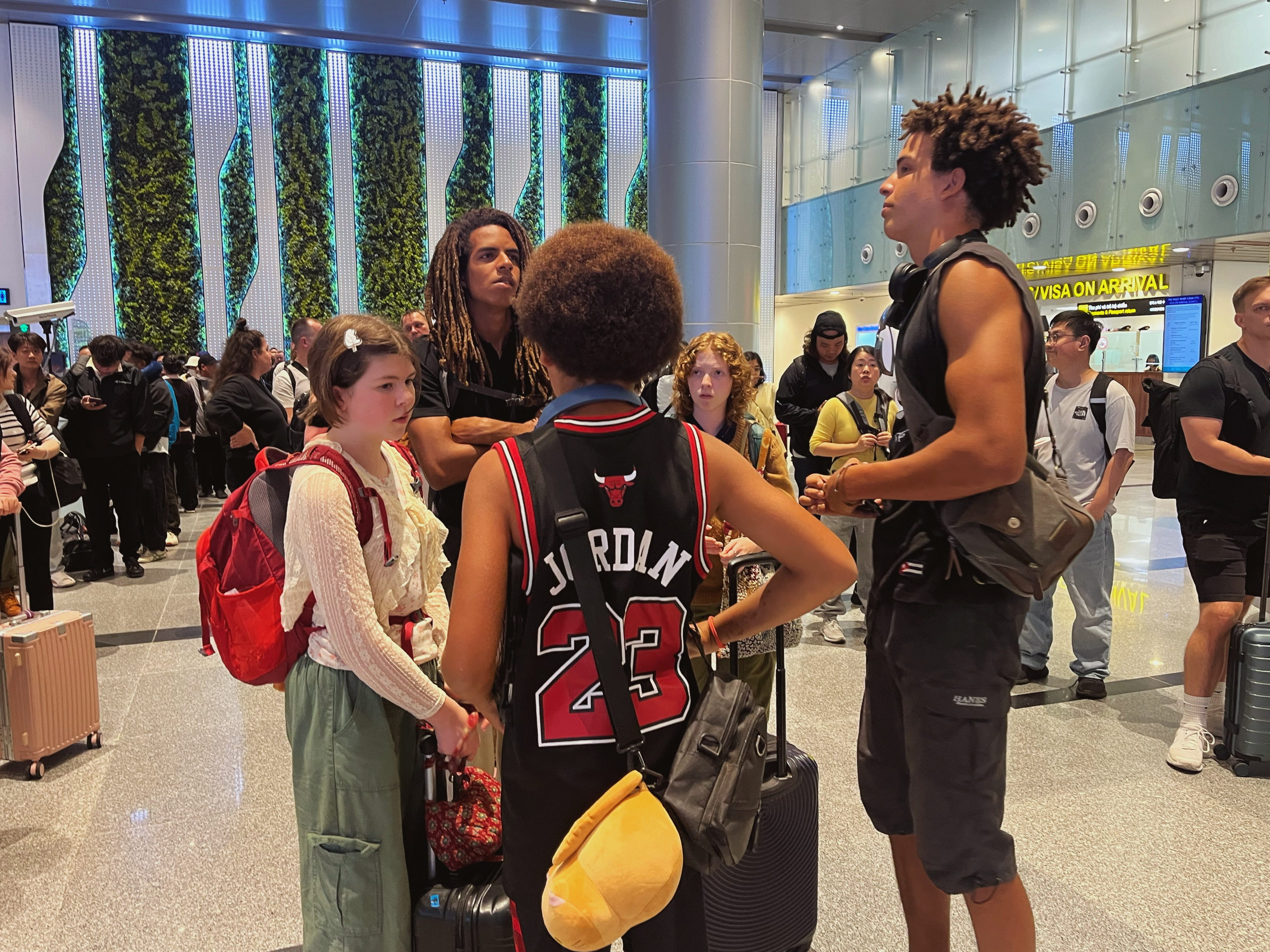
The visa issues resolve. We fly. The man beside me on the plane strums out a silent rhythm with a pick on his knee, using his left hand to mime the chords. The clouds are wispy. My husband is beside me. So many people have tiny things attached to their backpacks. Little chotchkes and stuffed animals. They must have some meaning. Everyone has so much to tell. So many stories with tiny things that have traveled along with them.
.
We travel. Dust comes with us from country to country. Dust like gold in the light. In a foodcourt, we talk about eyelashes and the lack of color on eyelashes and eyebrows. Everyone else in my family has thick black eyelashes and eyebrows. Mine need extra color to be visible. The young friend we are traveling with has three toned eyebrows and eyelashes. Her eyebrows are light blonde, slightly dark, and red.
“You know when people get snow caught in their eyebrows or eyelashes? Yours look like that, but with gold.” This is my son speaking. My tallest son. Seventeen, with kind eyes and words sometimes, intense and thoughtless words at other times. Trying to get through life while a head taller than most people, completely unable to hide. Solomon walking among the humans, Chinua says, when we catch sight of Solomon from afar. He means that Solo looks like a god. But I know he can feel like an alien.
And then, he reaches out with this gentle, rich gift. Looks like gold stuck in your eyebrows and eyelashes.
“That’s a very poetic way to say that,” our young friend says. She is eighteen. And how can Solomon know how young women can fret about being different? And how can he know that being different can be like a statue rather than an alien, or like flecks of gold, rather than, wow, you’re so pale, how on earth can you be so white?
I guess I’ve answered my question. And the answer to my other question is in the human things. The free things. I cannot change the way we have had to count and tally and take the cheapest option and how sometimes the cheapest option feels like the most demeaning, and how often I have to say no.
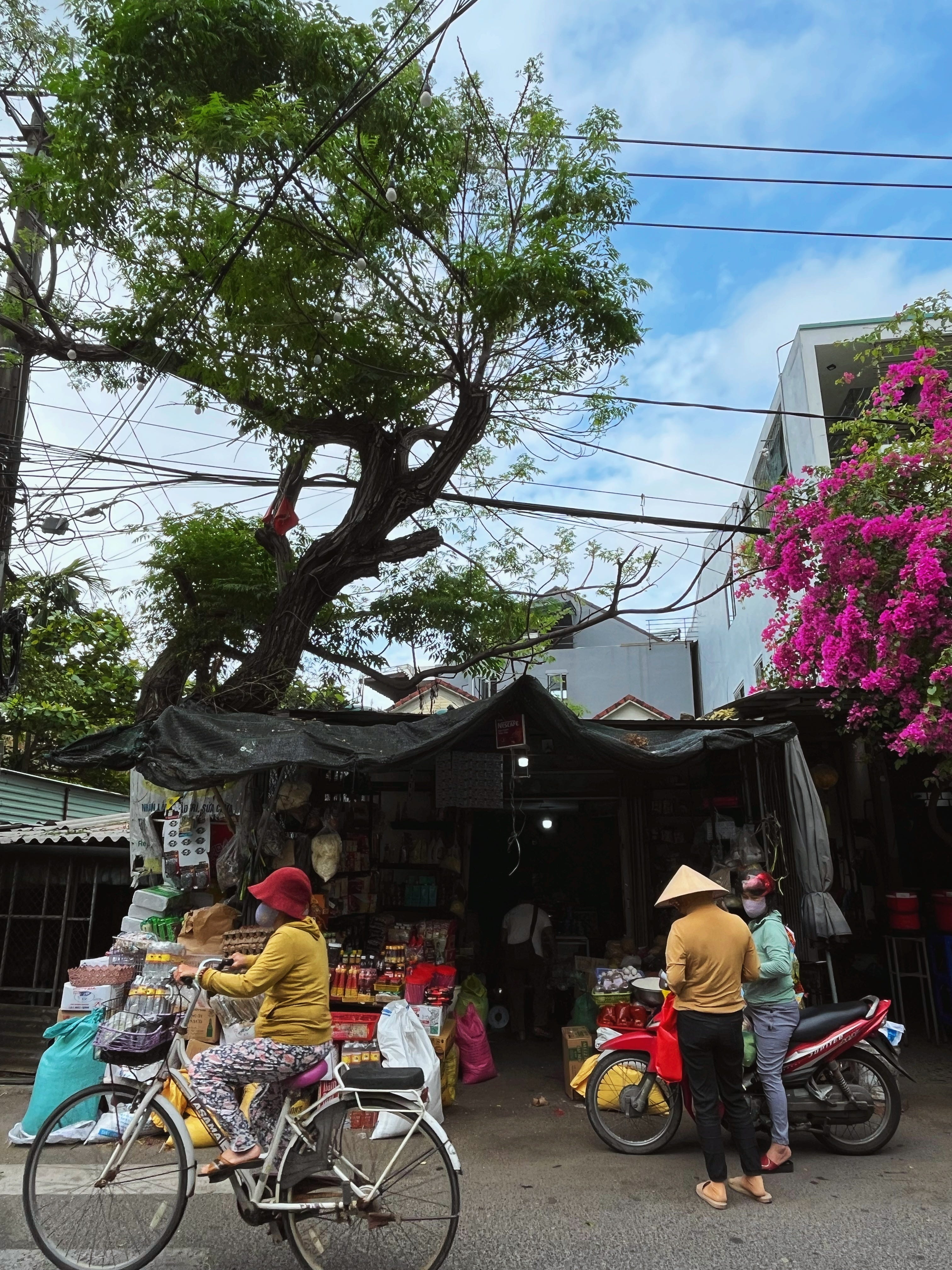
But they know how to put a seed in the ground and watch it multiply. They are rich in languages and countries and kindness. Their eyes are open to see the beauty of simple things. Let us metabolize all of it, not only part. Not only that I said no to new phones or clothes, but that I said yes to the whole world.
.
Links for you
📚 My books are here. If you would like to know where to start, try the first book in the World Whisperer Series or the first book in the Aveline Series. Or if you like poetry, you can try Everything Bright, Clear, and Beautiful, a Year of Poetry or God of All Flying Things.
🌟 Check out my book bundles (the best deal) here.
🧵 My writing mini-course is here— Following the Thread: Thirty Days of Guided Writing. It’s a month-long self-directed course about finding clarity and connection with the things in your life.
🎨 My dear daughter is working her way through art school and her Patreon account is here. She shares sketches and art pieces weekly and I love seeing her whimsical mind at work.
You inspire to live life as beautifully as you do.